
Mariam Varadashvili
Just a few days after the elections, it became known that the European Commission does not intend to recommend the opening of accession negotiations with Georgia. As stated in the annual enlargement report, the European Commission cannot recommend the opening of negotiations until the country changes its current course.
The situation is also complicated by the fact that the elections held on October 26 (in which, according to official data, the Georgian Dream won) are not recognized as legitimate by any opposition party that has crossed the threshold, nor by the President of Georgia. The European Union is talking about violations and demanding an investigation. In addition, none of the Western partners congratulated the Georgian Dream on remaining in power for a fourth term. Only the Prime Minister of Hungary visited the country, although the EU High Representative for Foreign Affairs and Security Policy, Josep Borrell, said that Viktor Orbán was not expressing the position of the European Union.
The Georgian government’s relations with its Western partners have deteriorated, especially after the re-initiation of the Russian law. Despite numerous calls to return to the path of democratic development, the government nevertheless adopted the Russian law, which prompted the European Union and the United States to announce the suspension of various types of financial assistance. This has already been reflected in the country’s budget. In the 2025 budget draft submitted to the parliament, the EU grant is being reduced from 92 million to 15 million GEL. Georgia has also lost 121 million euros in EU assistance for the regression of democracy.
What benefits does Georgia receive from the European Union?
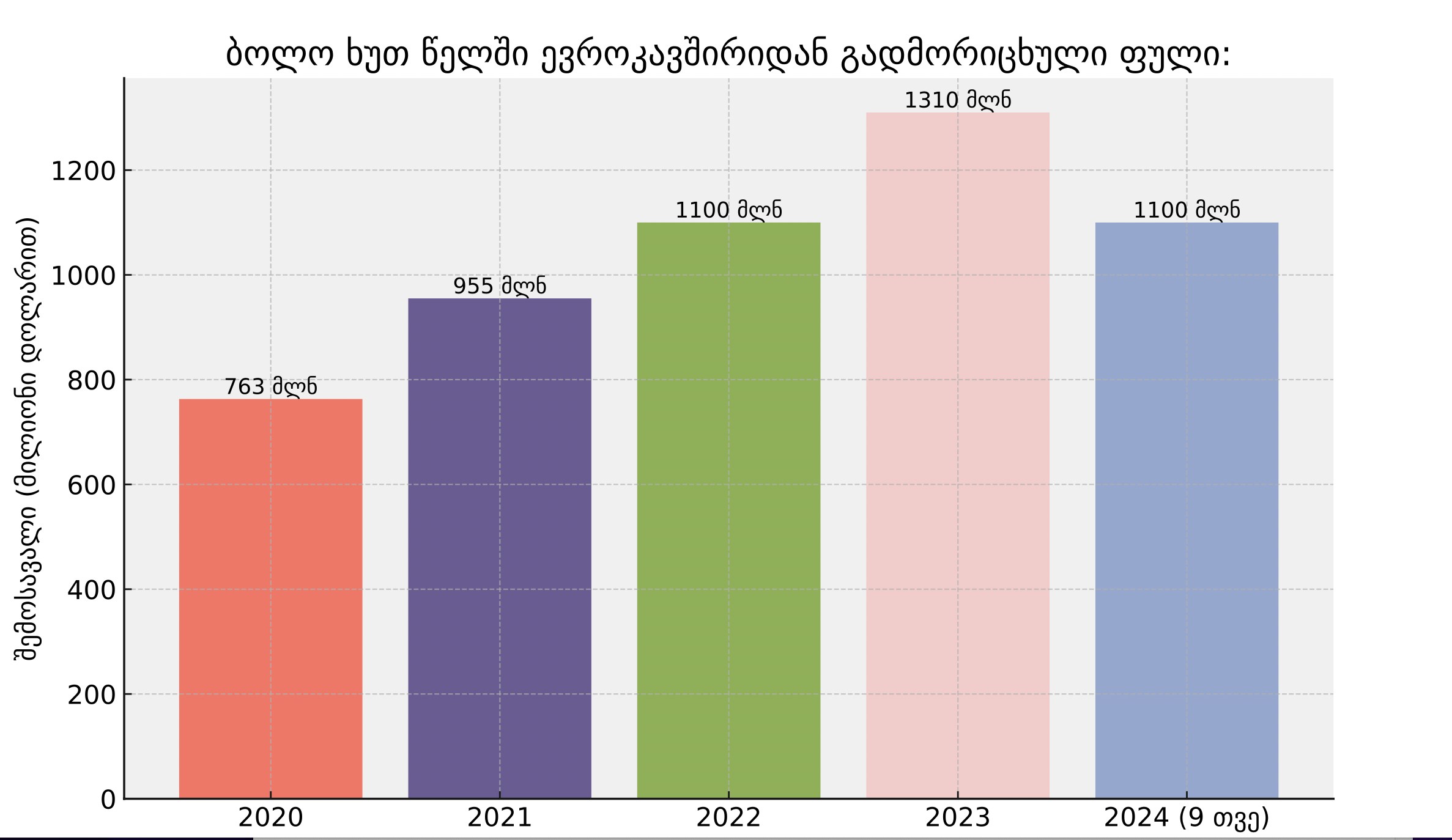
Georgia receives the most money from the European Union in the form of remittances, which Georgians working in EU countries send to their family members. Remittances have increased significantly in recent years, and this process has also been facilitated by visa-free travel to the EU. The largest number of remittances from EU member states this year came from Italy, Germany and Greece. In total, as of September 2024, almost $1.1 billion has been transferred to Georgia, which is 42% of total remittances, which is a record figure. For comparison, remittances from Russia this year have decreased to $446 million.
Tourism
Georgia’s economy also benefits from the EU through tourism. Unlike neighboring countries, visitors from the EU spend more in the country, so the government has repeatedly declared attracting tourists a priority. In the first nine months of this year, the country received more than $456 million from tourists from EU countries. In the first three quarters of 2024 [nine months], a total of about 348,000 visitors from EU countries arrived. To understand whether this is a lot or a little, we need to compare it with the total number of visitors. As a result, we see that the share of the EU in Georgian tourism is still small, only 7%.
What do we sell in Europe?
Despite the free trade agreement, the EU's share of Georgia's exports is declining. However, under the Deep and Comprehensive Free Trade Area [DCFTA] agreement, products manufactured in Georgia, if certain conditions are met, enter the EU's 450 million-strong market duty-free.
Georgia sold more than $390 million worth of products to the European Union this year [9 months of 2024].
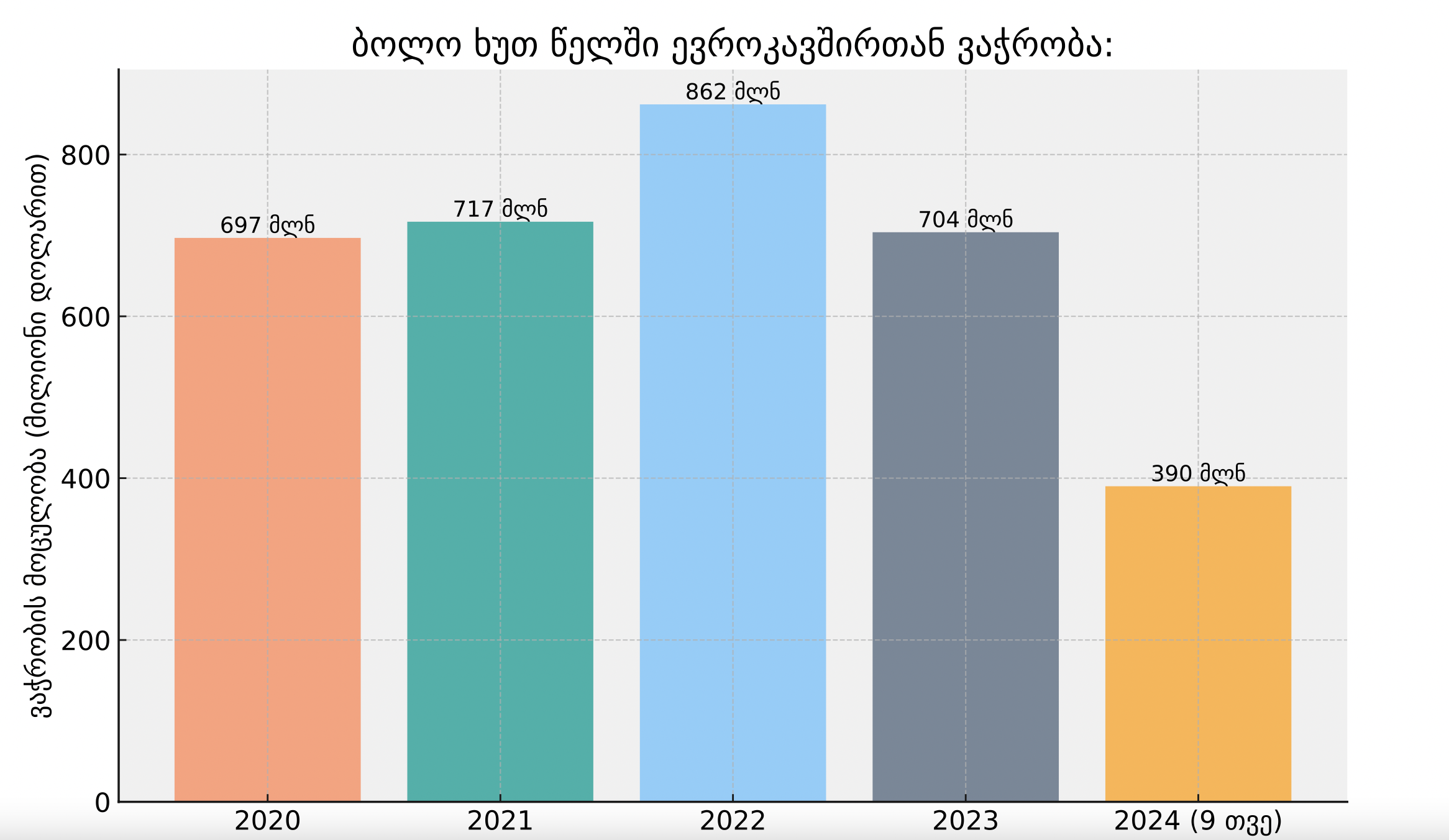
This year, we sold the most nuts and copper ores/concentrates to the European Union. After the war in Ukraine, the EU's share in Georgia's exports decreased, while the CIS's increased. This year, the EU's share in exports has decreased to 8%, while the CIS's has increased to almost 70%.
“The DCFTA creates an opportunity to access the markets of 27 countries, and Georgia should use this. However, for this to happen, it is necessary to improve relations with the European Union. In fact, the implementation of the free trade agreement is based on alignment with the values of the European Union,” says Tinatin Akhvlediani, a research fellow at the Center for European Policy Studies [CEPS] in Brussels.
The Export Development Association helps member organizations enter various markets, including the European Union. Its head, Gvantsa Meladze, says that the European Union is helping businesses to increase the promotion of Georgian products, and if this assistance is stopped, exports to the EU market will also decrease in the future.
"The further the country moves away from the path of European integration, the less funding there will be from the European Union, which helps promote Georgian products. There are many programs announced not only by the European Union, but also by Western donor organizations, which specifically promote the growth of exports of products to the European Union. If this funding is stopped, which is expected much sooner than the cancellation of any agreement, this will, of course, lead to a decrease in exports. Because in reality, one-time exports mean nothing. It is difficult to maintain a market in the European Union, and when companies enter this market, they also need to invest money in marketing in order to maintain this market.
"In addition, exports to the EU have always been more valuable because Georgian products are mainly exported there, which means they boost local exports. When we talk about exports, it also includes re-exports, for example, cars that Georgia does not produce and simply exporting them to another country will not bring as much wealth to the country [compared to local production]," says Meladze.
Energy cooperation with the European Union
The European Union already receives gas from Azerbaijan via Georgia. According to the Azerbaijani Ministry of Energy, Europe received 9.4 billion cubic meters of gas through the South Caucasus Gas Pipeline, which passes through Georgia, in the first nine months of 2024.
In addition, Georgia is currently cooperating with Azerbaijan and the European Union on the so-called Black Sea submarine cable project. If the project is successfully completed, Georgia's electricity system will be connected to Europe for the first time and in the future will have the opportunity to sell its electricity to the European Union. Today, Georgia is only integrated with the energy systems of neighboring countries and exports electricity, mainly to Turkey. Under the project, Europe will receive electricity from Azerbaijan via Georgia via an underwater power transmission line.
The Ministry of Economy told us that an environmental and social impact assessment and a geophysical and geotechnical survey of the Black Sea bed are planned.
“This project could bring great benefits to Georgia, a country with European aspirations, and turn it into an electricity hub,” said European Commission President Ursula von der Leyen in December 2022.
Foreign direct investment
In the first half of the year, more than $229 million in foreign direct investment [FDI] was invested in Georgia from the European Union. This is almost 30% of total investments. The volume of investments in Georgia has not been large in recent years, and in the first six months of 2024 it decreased even further.
"Georgia is a small and open economy, for which trade and investment are very important. Unfortunately, its economy is not based on production, the main part of the economy comes from services, which is directly related to international trade. Today we have a political crisis, and international partners have lost trust, which poses a great threat to the country's reputation. We should expect a decrease in investments, because investors have less trust in countries that are not supported by international partners and are in a political crisis," says Akhvlediani.
What benefits will Georgia receive from joining the European Union?
Georgia has had the status of an EU candidate country for almost a year, but due to the adoption of a Russian law, the European Council in June "de facto suspended" the country's EU accession process.
"The European Union is considering the gradual integration of candidate countries. This means that these countries are increasingly opening their way to the EU single market and receiving more assistance," says Tinatin Akhvlediani, and how much assistance will be provided, according to her, will depend on the reforms implemented.
“We can see this in the example of Georgia, whatever aid was allocated has now been frozen. In the case of reforms, not only would it be frozen, but more would come to Georgia. In addition, when a country becomes a member of the EU or is close to the accession process, the EU increases aid because it wants its member to be economically stronger, which would be an addition to its market, not a pressure. This means that Georgia would become economically stronger on the path to EU accession and would have more aid,” says a representative of the Center for European Policy Studies [CEPS].